Storage media solutions
Drives are handled separately — because they should be.
TAR buys hard disk drives, solid state drives and other storage devices in bulk, and handles them as a separate stream from the moment they arrive. Storage media is physically segregated, evaluated on its own, and routed to reuse or recovery. TAR provides secure storage media handling — not certified destruction.
What storage media solutions cover
TAR handles HDDs, SSDs and other storage devices as a distinct category, covering purchase, segregated handling, evaluation and routing to reuse or material recovery. Drives arrive both loose in bulk and still installed in servers, arrays and computers.
Why storage media is separated
Three practical reasons:
- Data. Storage media is the only part of a computer that may still hold information. Segregating it from the moment it arrives is simply the correct way to handle it.
- Value density. A pallet of enterprise drives can be worth more than the servers they came out of. Mixed in with chassis metal, that value disappears.
- Different outcomes. A healthy drive, a low-health drive and a dead drive have three completely different routes. Evaluating them together as "drives" loses money and creates waste.
Hard disk drives
Mechanical drives remain the largest single storage stream TAR handles. All brands and capacities are considered, and mixed lots are normal. TAR publishes explicit intake criteria for 3.5-inch drives so suppliers know before they ship — see 3.5″ HDD intake.
Solid state drives
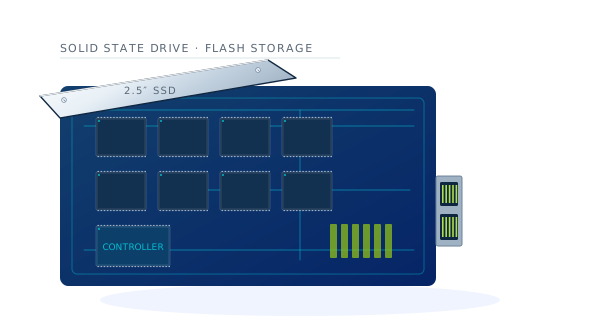
SSDs are evaluated separately from mechanical drives. Form factor, interface, capacity and endurance history all affect the route an SSD takes, and a drive that is no longer suitable for one workload is frequently still excellent for another.
Intake criteria in short
For 3.5-inch hard drives specifically, TAR considers new, used, low-health and dead drives. TAR does not accept drives that have been drilled, hammered, degaussed or physically damaged — those are already destroyed and have no reuse or evaluation route left. The full criteria, with illustrations of each condition, are on the HDD intake page.
What TAR does not claim
This needs to be unambiguous. TAR provides secure storage media handling. TAR does not provide certified data destruction, does not perform certified data erasure, and does not issue destruction or erasure certificates. If your organisation requires certified data destruction with documentation, that must be completed before equipment reaches TAR, or arranged with a specialised provider.
Storage formats
Mechanical and solid state, evaluated on their own terms.
Two very different technologies with two very different second lives. TAR does not treat them as one category.
Answers
Storage media questions
Short, direct answers. If your situation is different, ask us.
Storage media questions
Does TAR buy dead hard drives?
Yes. Dead drives are accepted, provided they are physically intact. A drive that no longer spins up still has a legitimate evaluation and recovery route. A drive that has been drilled, hammered or degaussed does not.
Why does TAR not accept degaussed drives?
Degaussing destroys the magnetic servo information the drive needs to operate. The drive can never be used again and cannot be meaningfully evaluated, which removes every route except material recovery.
Does TAR wipe or destroy data?
TAR provides secure storage media handling. TAR does not provide certified data destruction or certified erasure and does not issue certificates for either. If certified destruction is required by your policy, arrange it before the media leaves your control.
Can drives stay inside the servers?
Yes, and often that is simplest. Tell us whether drives are populated so the shipment is described accurately, and TAR will separate them on arrival.
What about 2.5-inch drives and SSDs?
Both are bought. The published intake criteria on this site cover 3.5-inch mechanical drives specifically; for 2.5-inch drives and SSDs, describe what you have and TAR will respond directly.
Related
Where to go next
Suppliers
Drives to move, in volume?
Tell us the quantity, brands, capacities and condition. Photographs of how they are packed help us respond accurately.
See 3.5″ HDD intake criteria