IT asset recovery
Deciding what an asset should become — before anyone calls it waste.
IT asset recovery is the process of taking equipment out of service and identifying the most valuable, most responsible outcome for each item. TAR coordinates collection, sorts and evaluates equipment, manages inventory records, and routes assets to reuse wherever reuse is genuinely possible.
What IT asset recovery covers at TAR
- Asset collection coordination — agreeing how equipment leaves site and reaches TAR.
- Sorting and evaluation — separating equipment by type, generation and condition.
- Inventory management — recording what arrived, in what state, and where it went.
- Reuse opportunities — identifying which assets can go straight back into service.
- Recovery solutions — extracting value from assets that cannot be resold whole.
- Responsible processing pathways — routing residual material appropriately, with specialised partners where required.
Where recovery sits in the IT asset lifecycle
An IT asset has a predictable life: procurement, deployment, productive service, refresh, and then a decision point. Recovery is that decision point. It is the only stage where a genuine choice still exists between reuse, resale, parts recovery and material recovery — and once equipment is treated as waste, that choice is gone permanently.
This is why TAR treats evaluation as the important step rather than a formality. Equipment that arrives described as scrap frequently is not.
Sorting and evaluation
Incoming equipment is separated by category, then by generation, then by condition. Enterprise hardware is assessed for completeness — rails, caddies, power supplies and modules materially change what a unit is worth. Storage media is separated from everything else and handled under storage media solutions.
Inventory management
Suppliers reasonably want to know what happened to what they sent. TAR maintains inventory records covering what was received, how it was categorised and which route it took. The level of detail is agreed with each supplier — some want a line-level record, others only need totals.
Reuse before recovery
TAR's order of preference is fixed: whole-unit reuse → component reuse → material recovery. This order is commercial as well as environmental. A working switch is worth many times the value of the metal inside it, so there is no tension between the responsible answer and the profitable one.
Equipment that cannot be reused moves into electronics recovery and WEEE solutions.
Honest limitations
TAR is a trading and renewal business, not a certified processor. TAR does not provide certified data destruction, does not issue destruction certificates, and does not guarantee regulatory compliance on a supplier's behalf. Where a supplier requires certified processes, TAR will say so and work with specialised partners rather than imply capability it does not have.
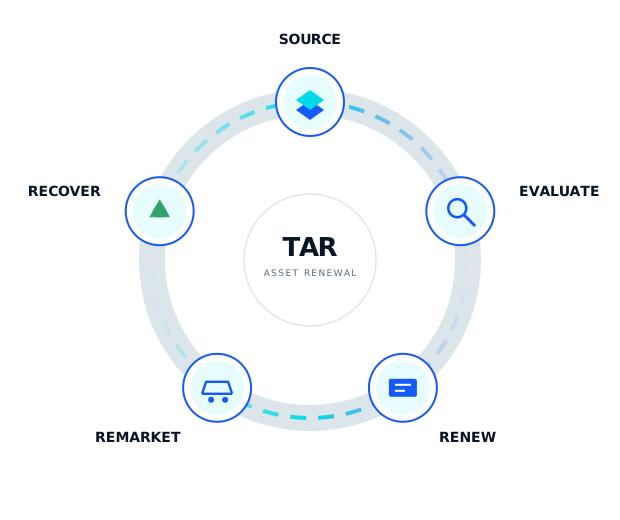
The route each asset takes
Five stages, and a deliberate order.
Source, evaluate, renew, remarket, recover. Material recovery sits last because it removes every other option.
Answers
IT asset recovery questions
Short, direct answers. If your situation is different, ask us.
IT asset recovery questions
What is the difference between IT asset recovery and recycling?
Recovery is a decision process; recycling is one possible outcome of it. Recovery evaluates equipment to find the most valuable responsible route — usually reuse. Recycling breaks equipment down into materials, which is only appropriate once reuse has been ruled out.
Does TAR provide certified data destruction?
No. TAR does not offer certified destruction services and does not issue data-erasure or destruction certificates. TAR provides secure storage media handling and will work with specialised partners where certified processes are required.
Can TAR handle a full data-centre decommission?
TAR coordinates collection and buys the resulting equipment. The physical decommissioning work on site is normally carried out by the operator or their chosen contractor; TAR takes the equipment from that point. Tell us the scope and we will be clear about which parts we can take on.
What records does TAR keep?
TAR records what was received, how it was categorised and which route it took. The reporting detail is agreed with each supplier at the start of the relationship.
Suppliers
Decommissioning equipment soon?
Talk to TAR before it is treated as waste. The evaluation is where the value is either found or lost.
Start Supplier Discussion