IT asset trading
A working buyer for surplus IT hardware — in volume, and again next quarter.
TAR buys used and surplus IT equipment from international suppliers and remarkets it into global buyer markets. We purchase servers, storage media, laptops, networking equipment and components in bulk, source hardware against buyer requirements, and prioritise suppliers who generate equipment regularly rather than once.
What IT asset trading covers at TAR
IT asset trading is the commercial half of asset renewal. Recovery decides what an asset should become; trading finds the market that agrees. At TAR it covers five activities:
- Purchase of surplus IT equipment — buying hardware outright from businesses that no longer need it.
- Global IT hardware sourcing — locating specific equipment on behalf of buyers who have a stated requirement.
- Bulk inventory acquisition — taking on mixed pallets, full decommissions and recurring volumes rather than single units.
- Asset resale — selling equipment on into markets where it still has commercial life.
- Equipment remarketing — preparing, describing and positioning equipment so it reaches the right buyer rather than the fastest one.
What TAR purchases
TAR buys across the full IT hardware range: servers and enterprise hardware, storage media and arrays, laptops, desktops and workstations, networking equipment, components, Apple devices and displays. Additional IT and electronic equipment is considered — tell us what you have.
Condition ranges widely. Equipment does not need to be tested, cleaned or sorted before you contact us; in most cases it is more efficient for TAR to evaluate it than for a supplier to guess.
Bulk inventory acquisition
Most of what TAR buys arrives as bulk: a decommissioned rack, a pallet of returned notebooks, a gaylord of pulled drives, or the residual stock left when a lease fleet is refreshed. Mixed lots are normal and welcome.
What helps most is an honest description. A list that says "approximately 400 mixed 3.5-inch enterprise drives, untested, some known dead" is far more useful than an optimistic one, and leads to a faster and more reliable conversation.
Remarketing and resale
Once equipment is evaluated it is routed to the market where it holds the most value. Demand differs by region: enterprise storage and server hardware move strongly into some markets, business notebooks into others. TAR's buyer network across the UAE, Malaysia, Indonesia, Hong Kong, Pakistan, India and Bangladesh exists so that a single supply stream can be split intelligently instead of sold as one lot at the lowest common price.
What affects the value of used IT equipment
Suppliers ask this constantly, so here is the honest version. Value is driven by:
- Generation and specification — how far the equipment is from current market expectations.
- Condition and completeness — whether caddies, rails, power supplies, chargers and components are present.
- Consistency — one hundred identical units are worth more per unit than one hundred different ones.
- Quantity and repeatability — recurring supply supports better arrangements than a one-off lot of the same size.
- Packing and shipment method — how the material travels changes the landed cost, which changes what can be offered.
Read more in how bulk IT assets are evaluated.
Reach
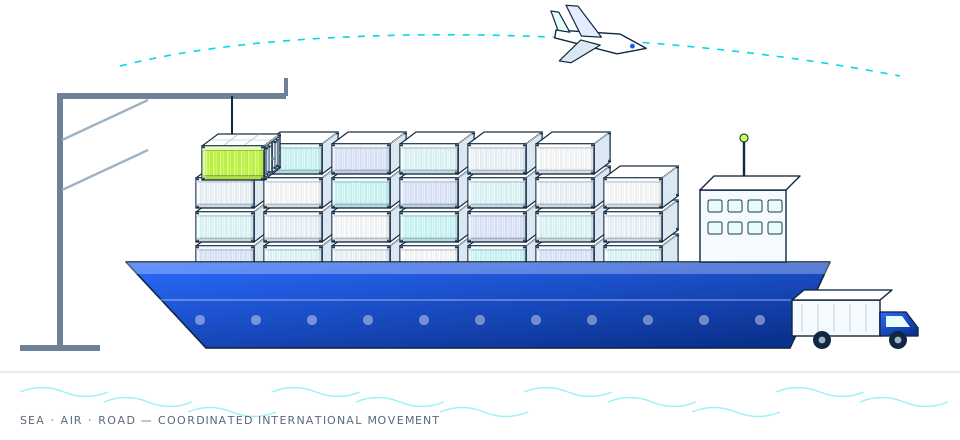
One supply stream, several destination markets.
Splitting a mixed lot across the markets that value each part is the difference between a fair price and a clearing price.
Answers
IT asset trading questions
Short, direct answers. If your situation is different, ask us.
IT asset trading questions
Who buys used IT equipment internationally?
Companies like TAR do — international IT asset traders that buy surplus hardware from ITAD companies, recyclers, asset recovery businesses and corporates, then remarket it into markets where used equipment is in demand. TAR buys from the USA, UK, Australia and Europe and sells into the UAE, Asia and other international markets.
Does TAR buy untested equipment?
Yes. Untested and mixed-condition equipment is normal. Describe it accurately and TAR will evaluate it. Guessing upward helps nobody — accurate descriptions lead to faster, more reliable arrangements.
What is the minimum quantity?
There is no published minimum. What matters more is whether the material recurs. A modest but regular stream is more valuable to TAR than a single large one-off lot.
How are prices decided?
Individually. Commercial arrangements are discussed based on product category, shipment method, business history and mutual agreement. TAR does not publish price lists or payment terms because the sensible arrangement differs for every supply relationship.
Can TAR source specific equipment for a buyer?
Yes. Send a requirement through Find Equipment with quantities, specifications and destination, and TAR will tell you honestly whether it can be met and roughly when.
Related
Where to go next
Products TAR handles
The full equipment range, with original illustrations for each category.
PROCESSSell Your Assets
The four-step supplier process and the supplier enquiry form.
GUIDEHow international trading works
What actually happens between a decommission in one country and a buyer in another.
Suppliers
Have equipment to move?
Send a rough list. TAR will tell you which lines are commercially interesting and which are not.
Start Supplier Discussion